Work / Shared Language for Recommendations
Designing a Shared Language for Recommendations
Amazon · UX Designer II · Summer 2025 – Winter 2025
Overview
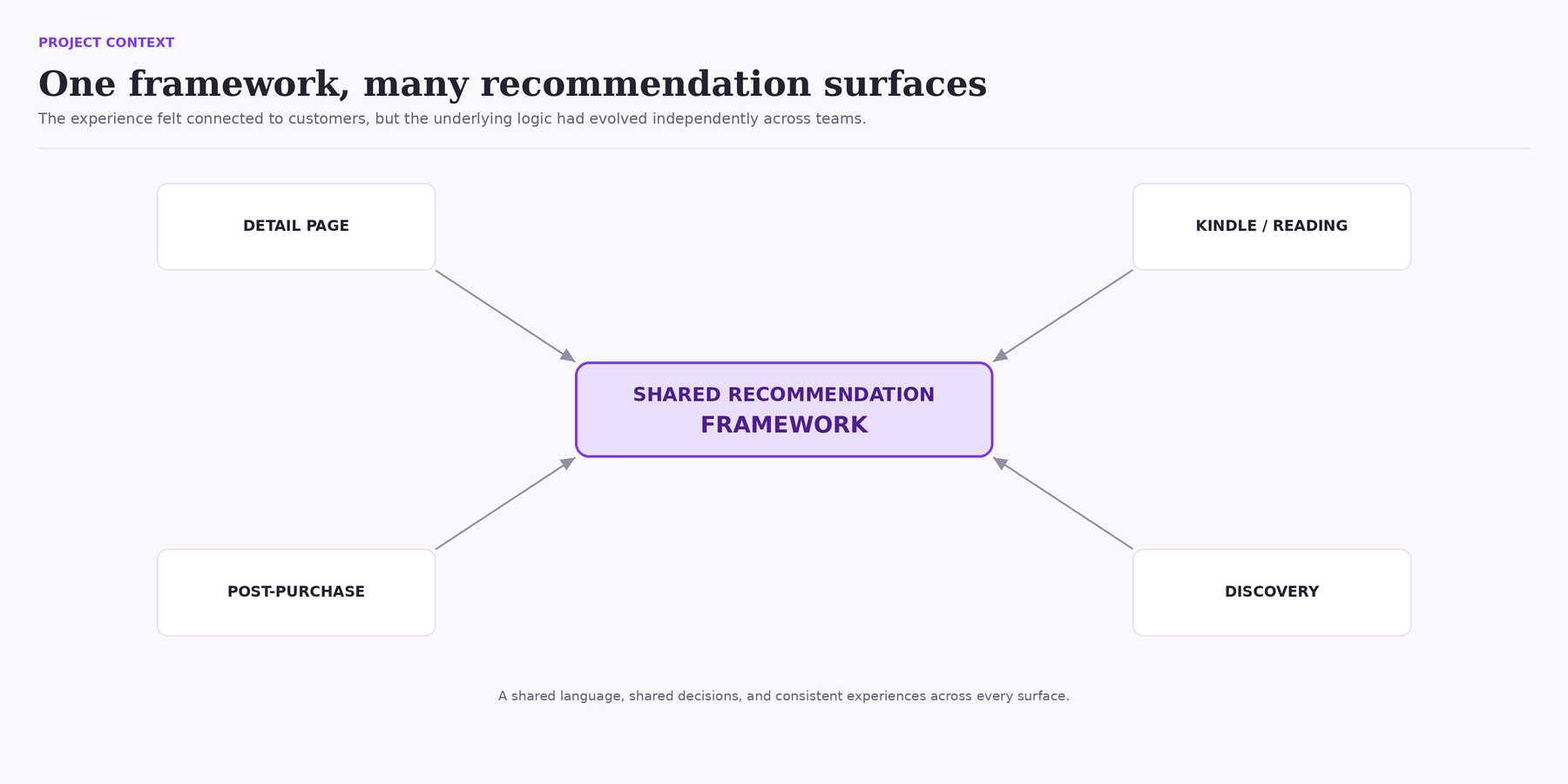
Recommendations appear across multiple Books journeys, from Detail Pages and post purchase experiences to Kindle and broader discovery surfaces. But the experiences had evolved independently, with teams using different signals, terminology, and priorities. The challenge was not another carousel or component. It was creating a shared way to define, prioritize, and explain recommendations so future experiences could be more consistent and reusable.
The challenge
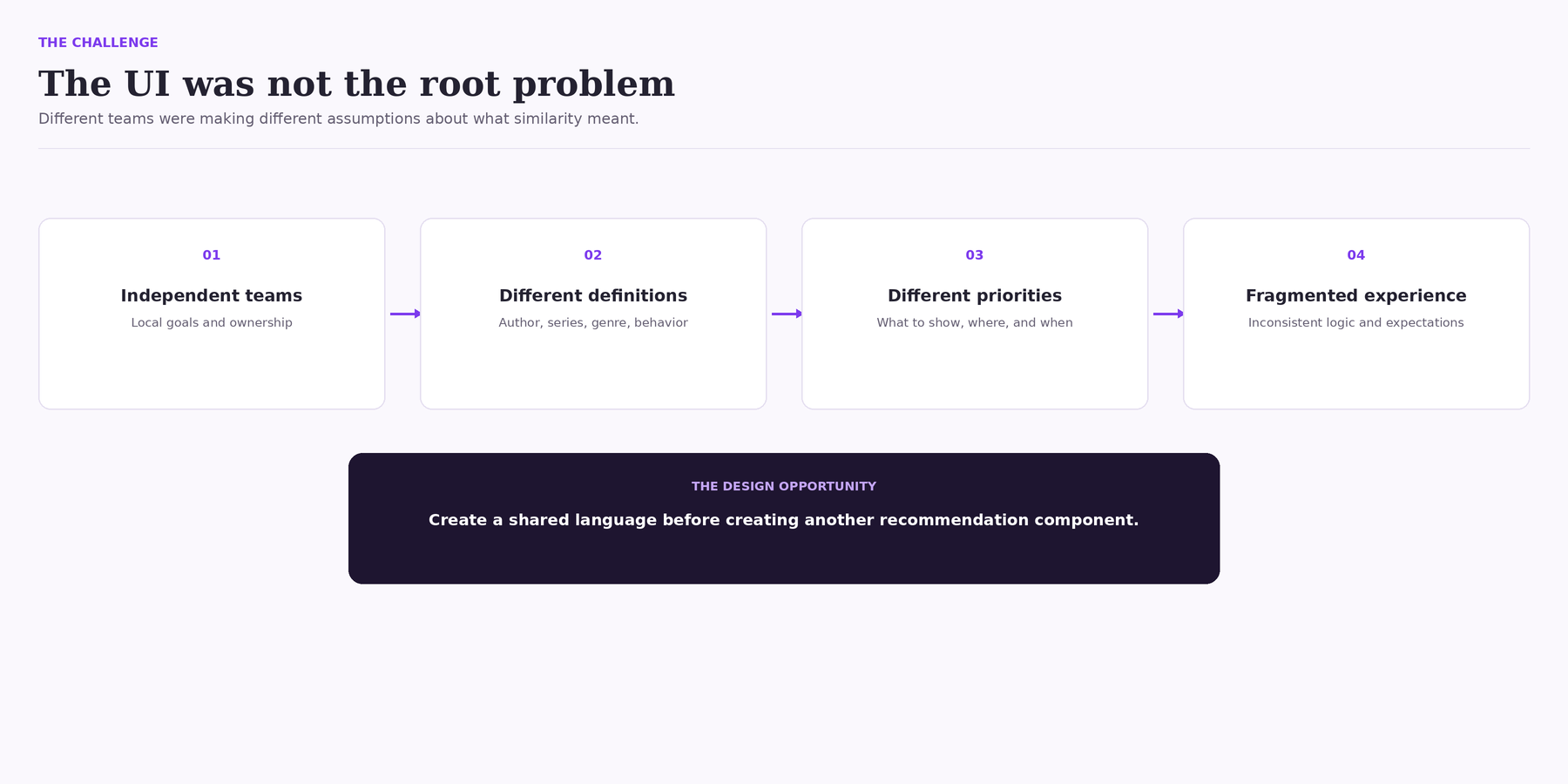
What is a Similarity? This is such a difficult question because if you were to ask your neighbor what a similarity is for them, it may be much different from your thinking. On an Amazon book detail page, a customer runs into several different recommendation sections in a single scroll: Customers also bought, Products related to this item, Best sellers in this genre. Each one is quietly making a different kind of claim about similarity, but none of them says what that claim actually is.
Take "Products related to this item." Related how? Same author? Same theme? Same vibe? The customer has no way to know, and neither, really, did the teams building these sections. "Customers also bought" is a behavioral signal, not a content one, it tells you what other people did, not why this book might matter to you. "Best sellers in this genre" isn't really about this book at all, it's a popularity list wearing a recommendation's clothes. None of this is wrong exactly. Each pattern is doing something reasonable on its own. But stacked together with no shared vocabulary behind them, the page ends up presenting several flavors of "similar," without ever naming the difference.
The customer feels it as noise: another row of covers, another reason to scroll past. And internally, without a shared language for what kind of similarity each section is actually offering, every team ends up re-solving the same question from scratch, with no way to agree on when each type of recommendation actually earns its place on the page.
The visible inconsistency began with inconsistent definitions and priorities.
Research and reframing
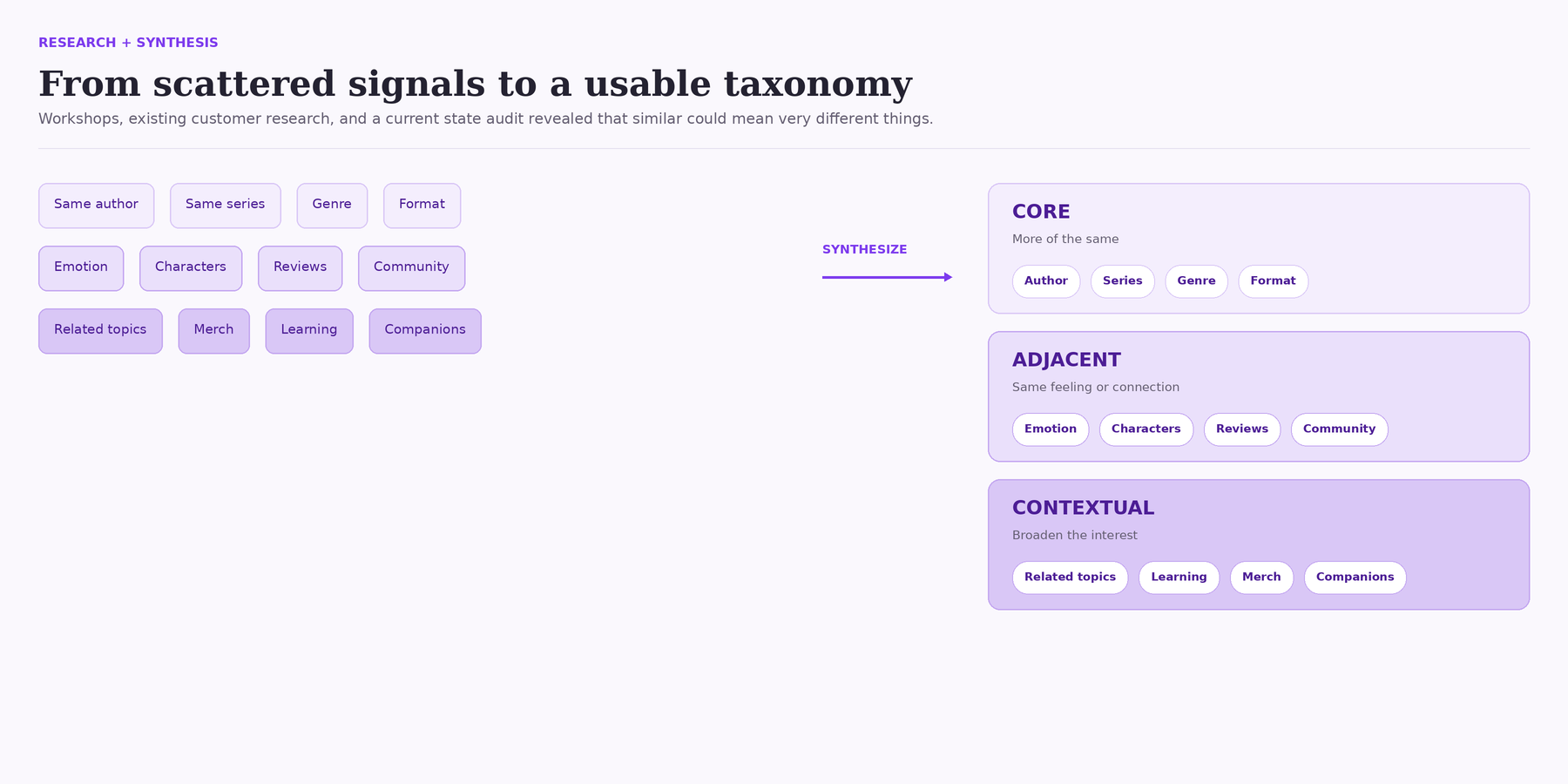
Rather than beginning with UI patterns, I stepped back and asked a more fundamental question: what actually makes two books similar? I reviewed existing recommendation experiences, worked through prior research with series customers, studied how other recommendation driven products communicated relevance, and held whiteboarding sessions with my product manager.
The synthesis revealed three insights: similarity is multidimensional, readers may connect through author, series, genre, characters, emotion, format, community, or topic. Customer intent changes the value of a recommendation, more of the same is different from the same feeling or help me explore further. And customers need context, a recommendation becomes more trustworthy when the relationship is explained.
I grouped the signals by what the customer actually needed, not by which team or page they came from.
The similarity framework
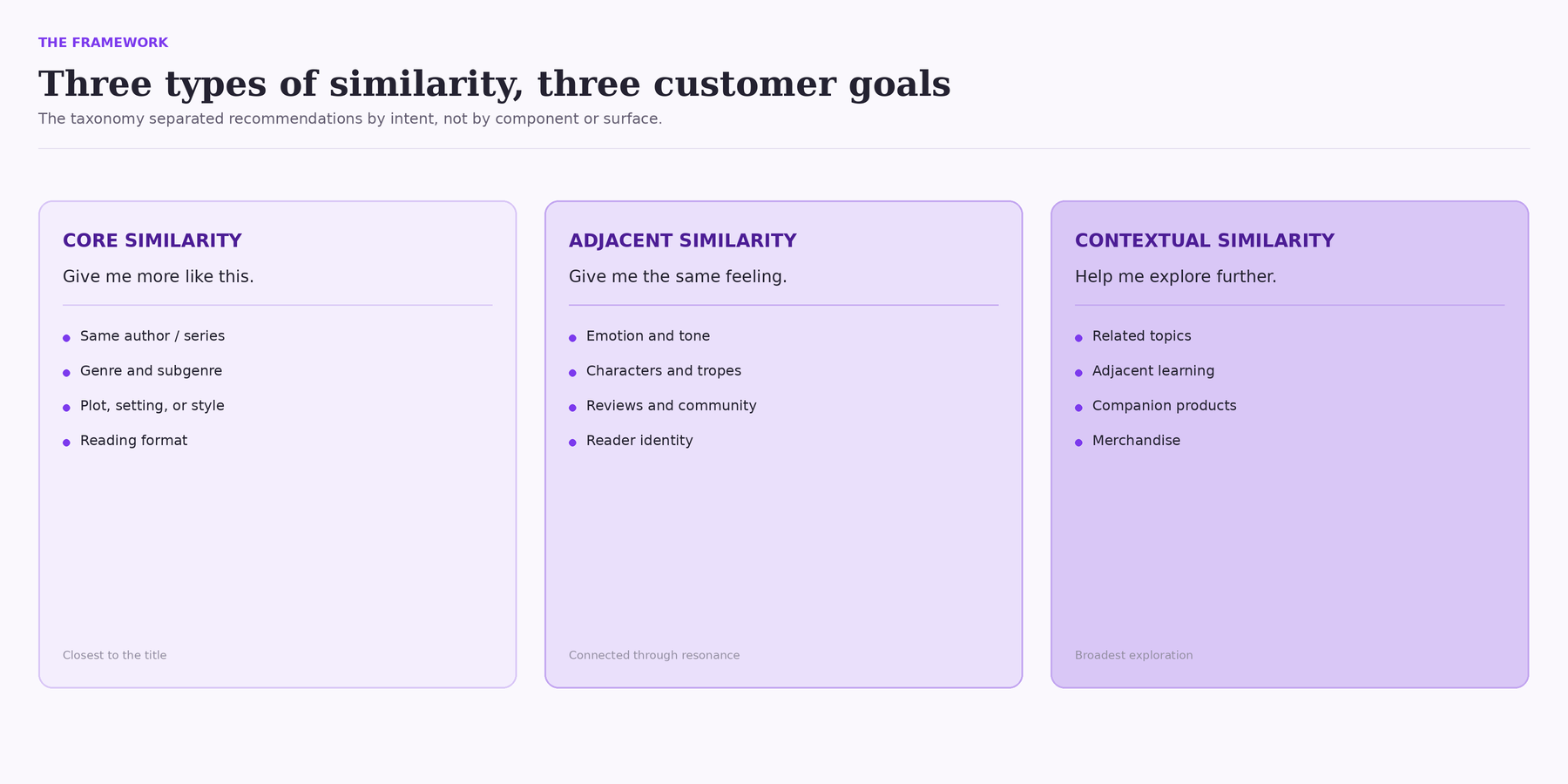
After several working sessions with my PM, sorting through what each signal actually did for the customer rather than which team or page it came from, three distinct types of similarity emerged. Not three arbitrary buckets, but three different jobs a recommendation could be doing, depending on what the customer actually needed in that moment.
Core similarities include the same author or series, similar authors or series, shared genre, setting, plot structure, style, or format. These are most useful when the customer is looking for continuity, for example on a Detail Page, immediately after purchase, or at the end of a series.
Adjacent similarities may include character dynamics, emotional tone, reviews, social conversation, community, or reader identity. They can support discovery when customers want something that resonates without being a near duplicate.
Contextual similarities can extend to related products or merchandise when the customer is exploring an interest rather than seeking another version of the same book.
Applying the framework
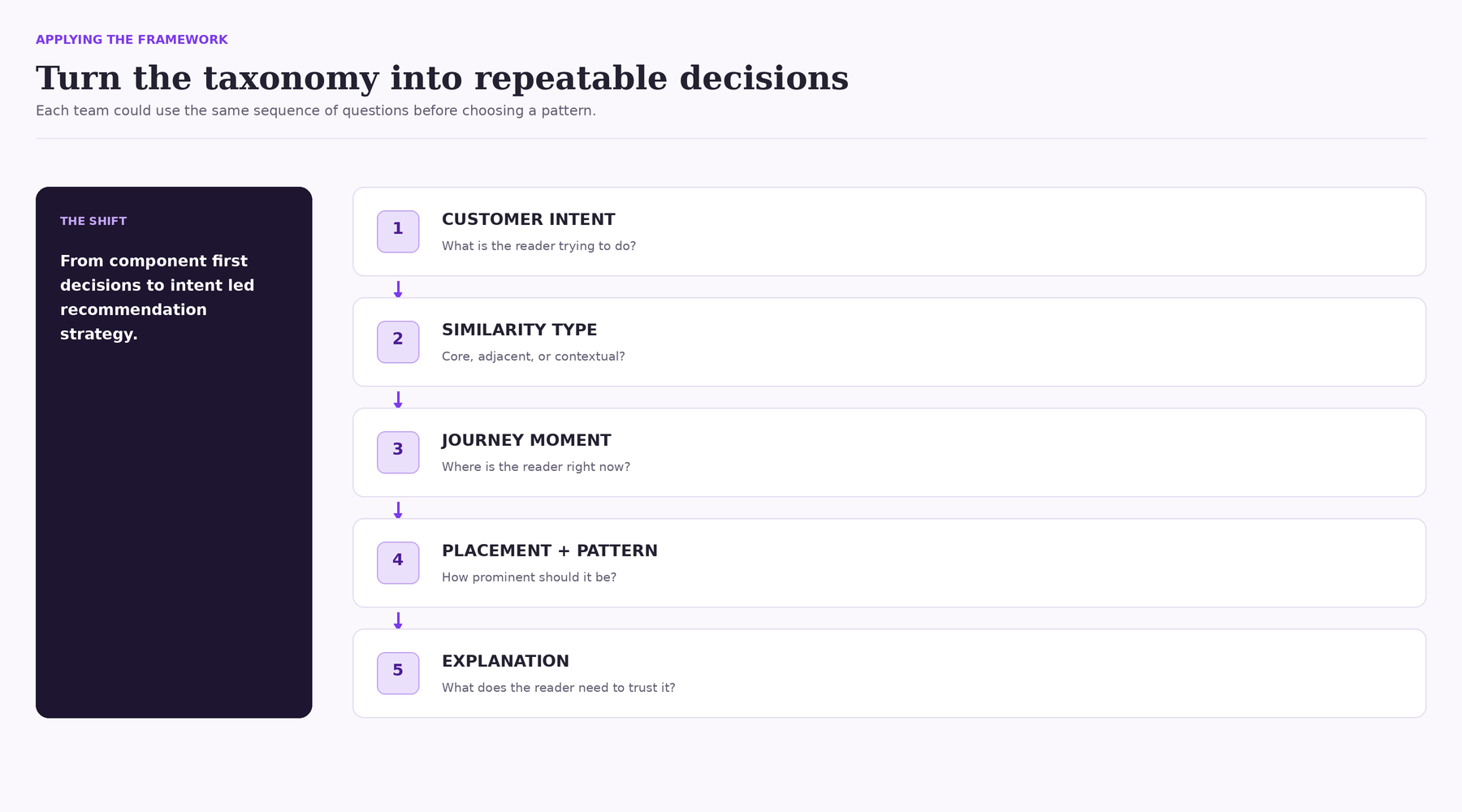
Categorizing similarities was only useful if it changed how teams made decisions. I translated the taxonomy into a repeatable sequence: start with customer intent, identify the appropriate similarity type, consider the journey moment, select the placement and pattern, then determine what explanation the customer needs.
The framework shifted conversations from component selection to customer intent and recommendation strategy.
Journey strategy
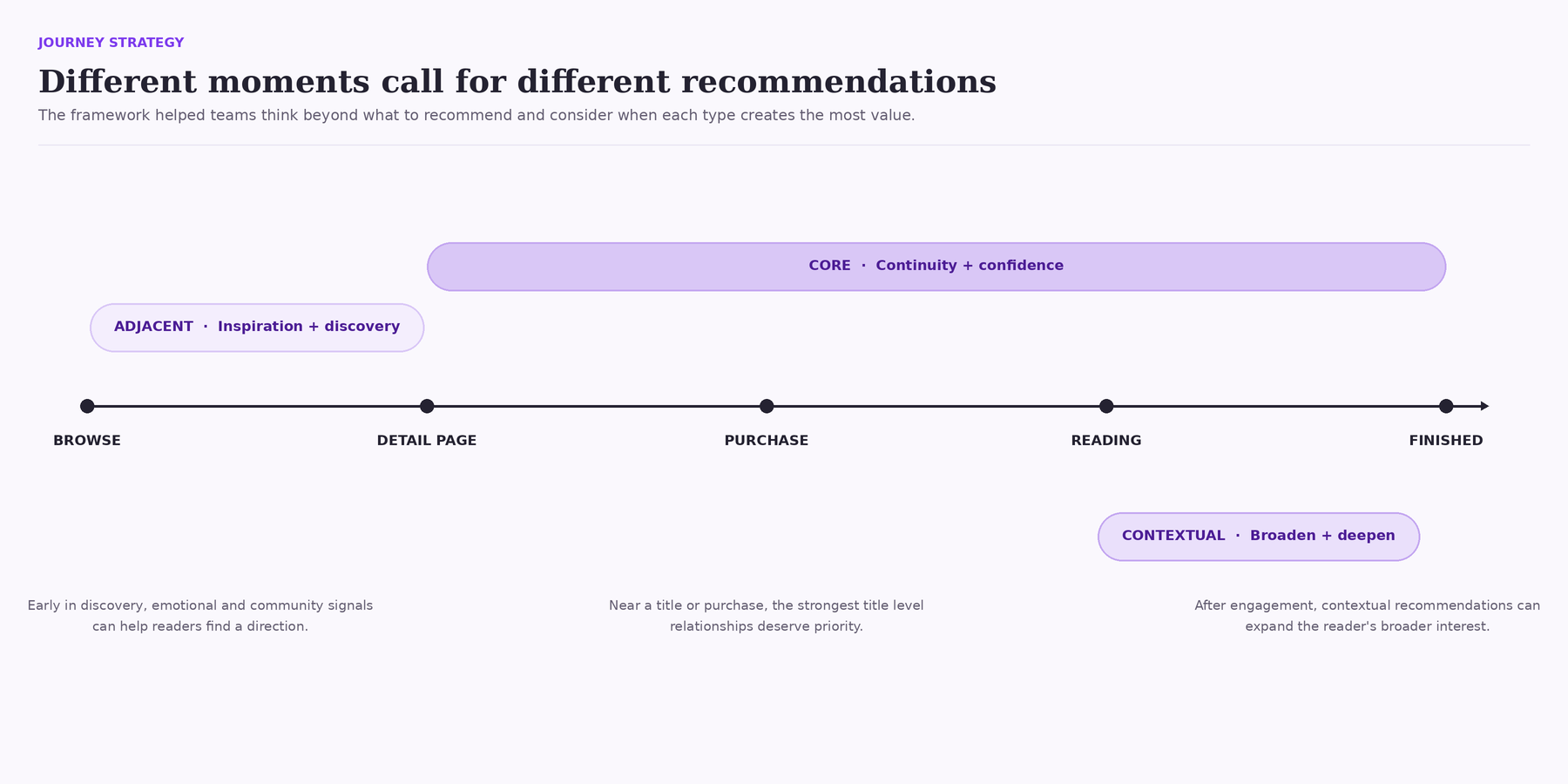
The framework helped teams think beyond what to recommend and consider when each type creates the most value: adjacent similarity early in discovery, core similarity near a title or purchase and throughout reading and finishing a book, and contextual similarity after engagement.
Designing trust
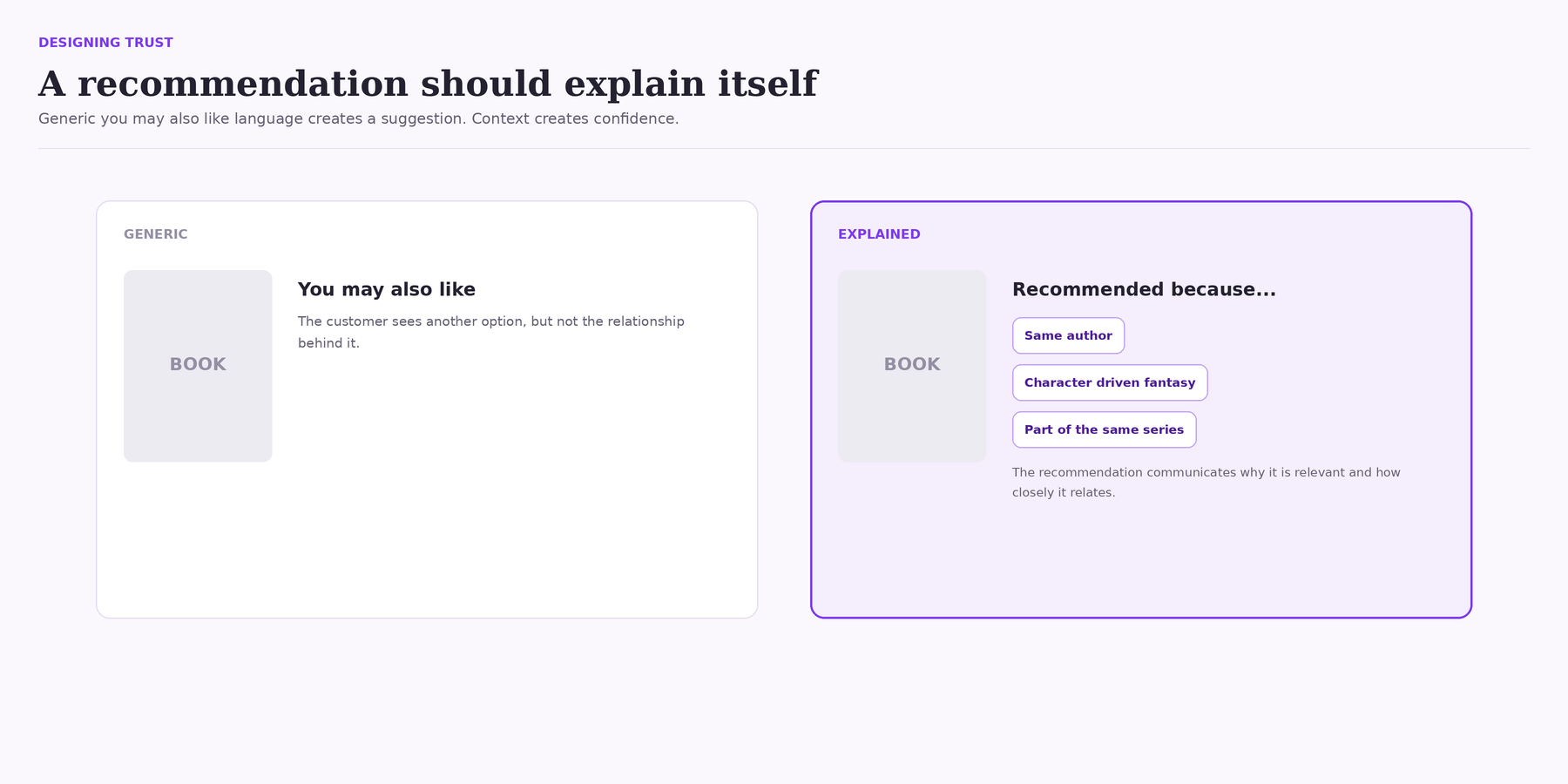
Existing patterns could tell customers that they may also like a title without explaining why. We hypothesized that Customers want to understand the signal behind a recommendation and how closely it related to the book they were viewing. Depending on the surface, that could mean similarity tags, supporting copy such as because you read, or lightweight metadata that names the author, series, genre, character, emotion, or topic connecting the titles.
Context turns a generic recommendation into a more understandable and trustworthy choice.
Driving organizational alignment
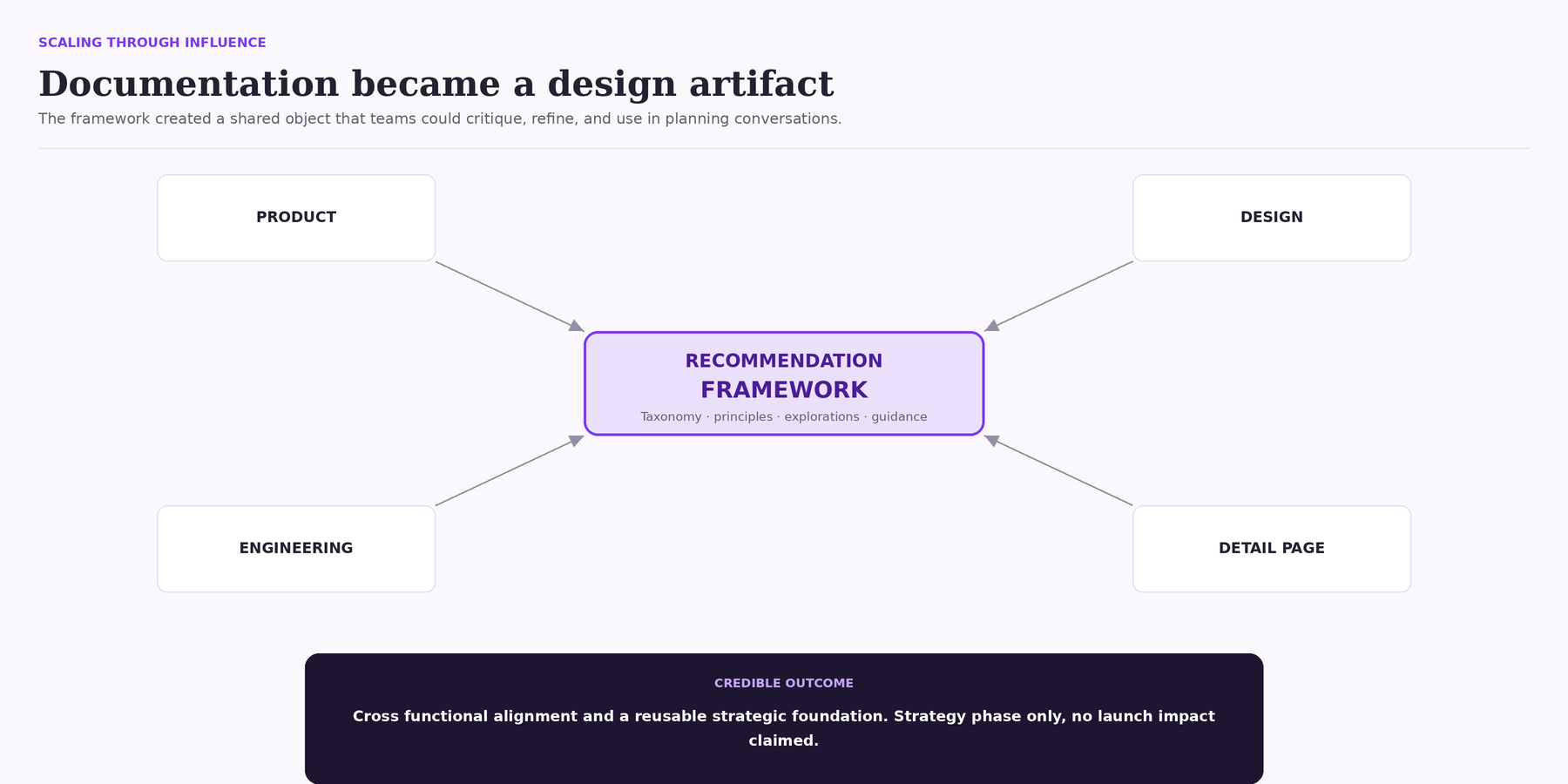
A framework only creates value if other teams understand and use it. I documented the taxonomy, principles, and exploratory concepts in a strategy document, then used it to guide recurring conversations with Product, Engineering, Design, and partner teams that surfaced recommendations. I presented the work to Product Management leaders and partners, including the Detail Page and Kindle Unlimited teams, gathered feedback, and refined the thinking as their own roadmaps evolved. The document gave teams a shared object to critique and a vocabulary for discussing recommendation intent beyond individual UI patterns.
Credible outcome
The credible outcome was alignment and a reusable strategic foundation.
Reflection
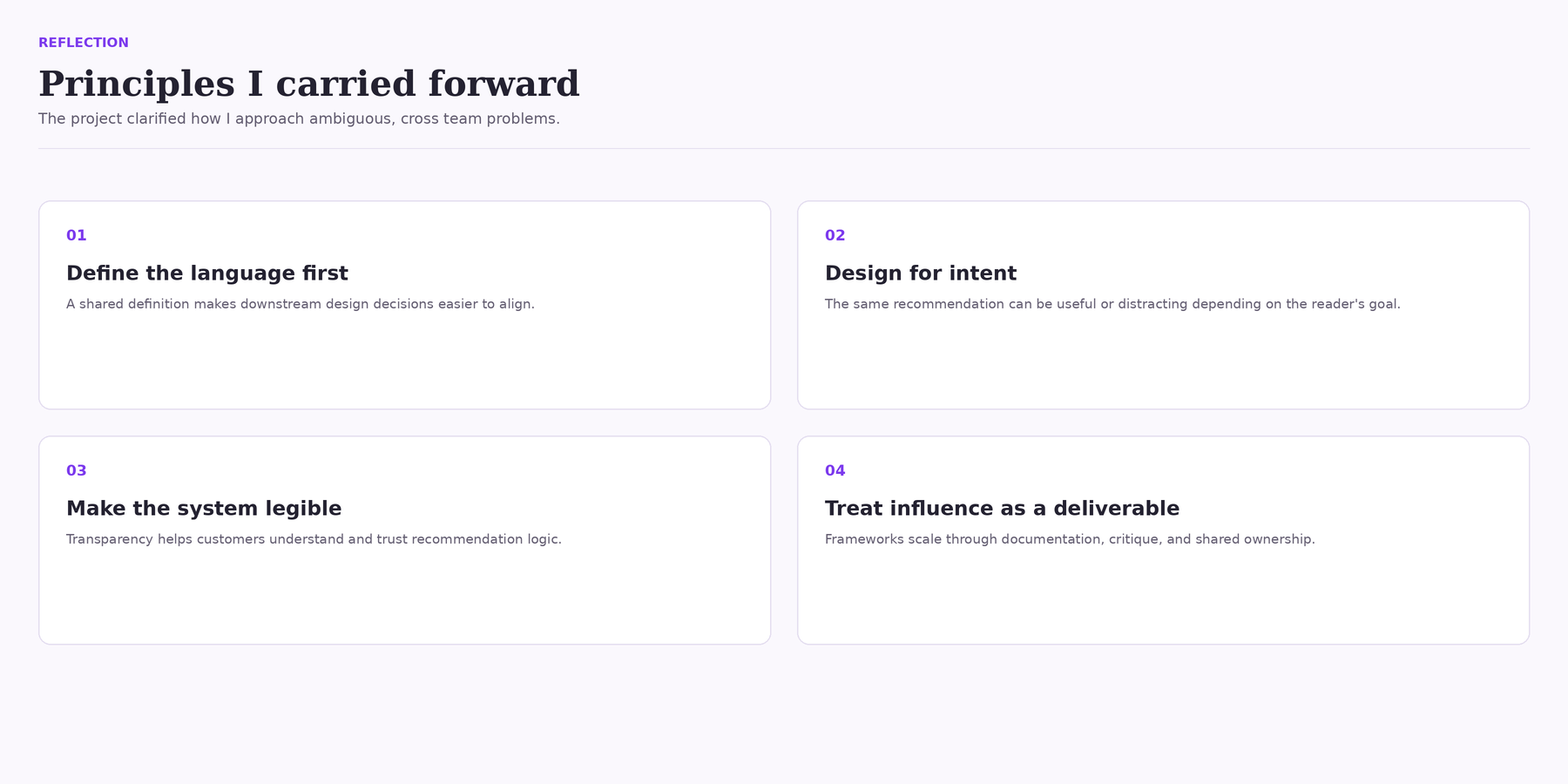
The strongest outcome was not a single recommendation component. It was a shared way to discuss what a recommendation was, which customer need it served, how strongly it related to the source title, and where it belonged in the journey.
The framework created three tangible outputs: a common vocabulary for Core, Adjacent, and Contextual similarity, a decision model connecting customer intent to priority, placement, and explanation, and a strategic foundation for future recommendation explorations across Books teams.
What I would do next
I would pilot the framework on a high traffic Detail Page surface, validate whether customers understand the similarity labels, and compare engagement and trust across recommendation types. I would also test where category boundaries blur, for example when a shared trope functions as a Core signal for one reader and an Adjacent signal for another.
Previous project
A La Carte RecipesNext project
Books Quickview